The Countdown Goes Global: How July 22 Crossed the Atlantic (and Got a Little Lost Along the Way)
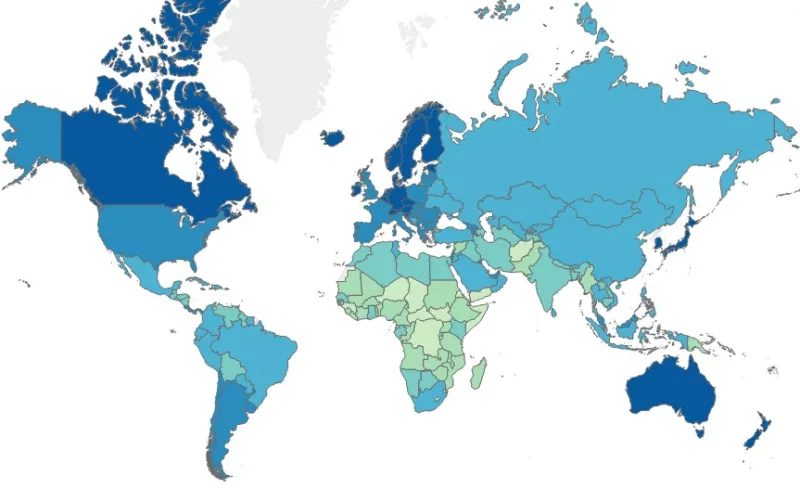
Photo: Social Progress Index, CC BY-SA 4.0, via Wikimedia Commons
America has always been pretty good at exporting its cultural moments. Hollywood blockbusters, Super Bowl parties in London pubs, Black Friday deals showing up on Australian shopping sites — the US has a long tradition of making its enthusiasms feel universal, whether the rest of the world asked for them or not.
July 22 is the latest entry in that tradition. What began as a homegrown countdown — rooted in American social media, amplified by American creators, and anchored to an American cultural context — is now showing up in group chats and fan communities from Manchester to Melbourne. And the way it's landing abroad says something genuinely fascinating about how the internet moves culture across borders in 2025.
The Hype Crosses the Ocean
Ask fans in the UK about July 22, and you'll get a range of reactions. Some are fully plugged in — following US-based accounts, participating in the same countdown conversations, building their own anticipation toward the date. Others are aware of it in the way you're aware of a party happening down the street: you can hear the music, you get the general vibe, but you're not entirely sure what's being celebrated.
"I've seen it everywhere on my feed for weeks," says one fan from Birmingham who's been tracking the countdown online. "I don't think I fully understand what's supposed to happen, but I'm invested anyway. That's kind of the magic of it, right?"
That sentiment — invested despite incomplete information — turns out to be remarkably common among international participants. The feeling of the countdown travels better than the specifics. People outside the US are catching the energy without always catching the context, and for many of them, that's apparently enough.
The Time Zone Problem Nobody Talks About
Here's a logistical wrinkle that American fans rarely have to think about: July 22 doesn't arrive everywhere at the same time. When the clock strikes midnight on the East Coast, it's already the early hours of July 23 in London. Sydney is nearly a full day ahead. Tokyo is further still.
For a countdown built around a specific date, this creates some genuinely awkward questions. Do international fans celebrate when July 22 arrives in their time zone, or do they sync up with the US? Do they stay up to watch something happen in real time, knowing it'll be 3am locally? Or do they just catch up in the morning and accept that they'll be slightly out of sync with the main conversation?
Fans have developed their own informal solutions. Some international communities have designated "US midnight" as the real moment, treating it like New Year's in Times Square — something you watch happen elsewhere and celebrate vicariously. Others have leaned into their time zone advantage, claiming they'll experience July 22 first and reporting back to American followers.
It's a small thing, but it's revealing. Countdown culture assumes a shared present moment, and the globe doesn't really offer that.
What Gets Lost in Translation
Beyond the logistics, there's a subtler translation problem. American cultural exports often carry layers of context that don't fully survive the journey. References that land perfectly for a US audience can feel slightly off-key elsewhere — not wrong, exactly, but like a joke explained rather than told.
With July 22, this shows up in how different countries are interpreting what the countdown is for. In the US, the anticipation tends to feel specific, even if the object of that anticipation remains delightfully ambiguous. Abroad, the countdown sometimes gets reframed through a local lens — mapped onto a domestic celebrity, a regional event, or a cultural moment that has nothing to do with the original American context.
Is that a problem? Honestly, it depends on your perspective. Purists might argue that a July 22 countdown detached from its original meaning is just noise. But there's another way to read it: the date has become a format, a template for collective anticipation that people are filling with their own content. That's not dilution — that's adoption.
Canada and Australia: The Closest Translations
If any countries are getting the full July 22 experience without too much cultural static, it's probably Canada and Australia. Both have deep pipelines to American pop culture, both share a language, and both have significant fan communities that operate essentially in real time with US social media.
Canadian fans, in particular, often describe participating in American countdown culture as second nature. "We're always doing this," one Toronto-based fan noted online. "We watch the same shows, we follow the same creators. July 22 is just the latest thing we're doing together."
Australia's relationship is a bit more complicated by the time difference, but the enthusiasm is genuine. Australian fan communities have become known for being among the most energetic early responders to US cultural moments — partly because their morning often overlaps with peak American evening activity, creating a natural window for cross-timezone conversation.
The American Export Question
There's a bigger question lurking underneath all of this, and it's one that comes up every time American culture goes global: is this genuine connection, or is it cultural dominance wearing a friendly face?
The honest answer is probably both, and that's okay to sit with. The internet has created genuinely shared spaces where people from different countries can participate in the same moments in real time. That's new and kind of remarkable. But those spaces are not neutral — they're shaped by the platforms, the creators, and the cultural assumptions of whoever built them, which is disproportionately American.
International fans aren't passive recipients, though. They remix, reinterpret, and sometimes outright subvert American cultural exports in ways that create something new. The July 22 countdown that's circulating in fan communities in Seoul or São Paulo isn't identical to the one in Chicago. It's been adapted, filtered, and made local in ways that American participants might not even notice.
A Date Without Borders (Sort Of)
As July 22 gets closer, the global conversation is only going to get louder. International fans will keep finding their own ways into the moment, time zone complications and all. The countdown will mean different things in different places, and that's probably fine — maybe even good.
What it reveals, more than anything, is how powerful a shared date can be as an organizing principle. You don't need everyone to agree on why July 22 matters. You just need enough people to agree that it does. And at this point, that agreement has gone well past America's borders.
The countdown is officially a global event. The translation is imperfect. And honestly? That's what makes it interesting.